|
 |

From "The Ballad
of the Northern Lights" by Robert Service
by
Dr. Neil Davis (reprint)
The Aurora,
also known as the Northern Lights, has mystified
people down through the ages, scientists,
poets, and lay persons alike. Written records
of so-called "great auroral displays"
date back more than two thousand years.
Sometimes the
Aurora over Alaska and other auroral zones
is barely visible or appears colorless and
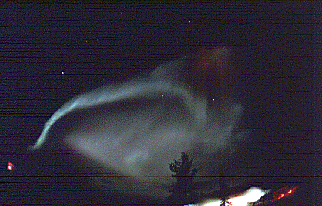
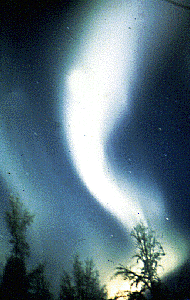
unmoving. But at other times the auroras can
be incredibly bright, multihued and fast moving.
Tall green curtains of lights, red tipped
at their bottoms, stretch from horizon to
horizon. They ripple and sway, fold and unfold,
then suddenly disappear, only to reform in
a new shape minutes later.
For those who
live in Alaska, the Aurora is a part of northern
life. Fall, winter and spring is the special
season for viewing the great lights for residents
and off-season visitors. Some Alaskans have
"Aurora Alerts;" when a display
begins, the first person to spot them begins
a phone tree to get the word out.
|
 |
|
|
|
|
The "pulsating
Aurora" is one form of Northern Light common during
the post-midnight hours. It blinks on and off every few
seconds as though controlled by some mysterious unseen hand
in the sky flicking a switch.
The great auroral
displays are spectacular global events during which the
Aurora spreads down from the polar regions to cover as much
as two thirds of the earth's skies with bright, fast-moving
masses of light, often deep red in color.
The rare "great
auroral displays" follow one or two days of violent
solar flares in the vicinity of major sunspots. These solar
flares cast out vast streams of electrically charged particles
which stream down into the earth's atmosphere. These particles,
mostly electrons and protons, are steered away from the
tropical regions by the earth's magnetic field.
Striking the
gases of the earth's high atmosphere, the charged particles
glow. |
|
It is exactly the same thing
that happens in a television tube: complex streams
of electrons within the TV strike the phosphor coated
face of the tube, and cause it to glow, creating the
colored moving patterns we see from our living room
couches. Outside, at night, we can look up at that
great star-studded television tube in the sky; if the
Aurora is out and no clouds are about, the colored
patterns will be there too.
Even
though "great auroral
displays" appear infrequently, spectacular displays
of Aurora are common in Alaska and other auroral zone locations.
This is because the sun is always sending out a stream of
electrons and protons. They make up the solar wind which
blows constantly toward the earth and other planets.
Enough of the
solar wind particles come into the earth's high atmosphere
at the auroral zone to create continuous Aurora, summer,
winter, fall and spring.
|
|
Although
much is known about the Aurora, this fascinating phenomenon
still withholds some of its mysteries. For example, scientists
do not yet understand why the Aurora is so highly structured.
For the University of Alaska Fairbanks, this continues to
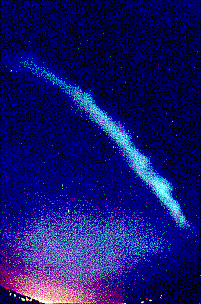
be an important area of study. The most beautiful Aurora
is composed of thin sheets that stretch upward a hundred
miles or more and extend across the sky from horizon to
horizon, like gigantic ribbons set on edge high above and
parallel to the earth's surface. These arcs and bands whip
and weave across the sky, and bright rays ripple along them
at fantastic speed. Some of these intricate multicolored
forms have a thickness of only 100 meters, about the length
of a football field, yet may be several hundred kilometers
tall and well over 1,000 kilometers in length.

It boggles the mind to realizeas
has been proven by simultaneous observation in the two hemispheresthat
these sharply defined auroral forms have an identical or
nearly identical mate in the southern hemisphere, out of
sight and almost a world away. Joined together by an invisible
magnetic bond that arches far above the Equator, each pair
of mated auroral dancers move across the cold polar skies
in perfect harmony. Each motion or brightness change in
one hemisphere is mirrored in the other, on a time scale
of less than a fraction of a second.
A most curious and highly
controversial question involves auroral sound. Although
I've never heard one, my wife has and so have several scientists
I know. Some reports of hearing noises associated with auroral
displays may be erroneous impressions, but I am convinced
many others are not. Hundreds of written reports indicate
noises are sensed when a particular type of fast-Aurora
is nearly overhead. Some people sense whistling and crackling
noises, even when they close their eyes.
|
 |
The reports of auroral sound
make it certain that the unknown cause of the apparent sound
is in the vicinity of the hearer, not in the Aurora itself.
Most likely, the reported noises are related to electrical
phenomena which accompany certain types of bright Aurora.
No matter how many auroras
one may have seen, a good high-latitude display, as seen
in Alaska, sends tingles up the viewer's spine. Even a moderate
display seen at the auroral zone in the 49th state can be
far more exciting to watch than one of the rare "great
displays." The best of words and photographs fail to
capture the magnificence of the high-latitude Aurora, although
some of Robert Service's poetry may come close.

THE AURORA
has a curtain-like shape, and the altitude
of its lower edge is sixty or seventy miles, about ten times
higher than a jet aircraft flies.
AURORAS OCCUR
along ring-shaped regions around the
north and south geomagnetic poles. Fairbanks, Alaska, is
a good place for Aurora watching because it is under this
region in the north, where people see Aurora Borealis, or
northern lights; the southern Aurora is Aurora Australis.
LIKE A NEON
SIGN, auroral light is produced
by a high-vacuum electrical discharge. It is powered by
interactions between the sun and earth. The light is a glow
from atoms and molecules in the earth's upper atmosphere.
|
|
THE
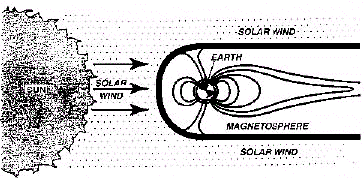
SUN IS a ball of gases that is
so hot its outermost part blows away as the solar wind.
Consisting of charged particles, this tenuous gas travels
to earth in about three days. Because the earth's magnetic
field prevents the solar wind from penetrating our atmosphere,
its solar particles stream around our planet, encasing earth
and its magnetic field within a comet-shaped cavity called
the magnetosphere.
THE SOLAR
WIND powers the gigantic electrical
discharge process, causing the magnetosphere to behave as
a generator that produces up to ten million megawatts of
electrical power.
THE UPPER
ATMOSPHERE contains, at the lower
edge of the Aurora, a thin and partly ionized layer called
the ionosphere. Reflected by the ionosphere, radio waves
can propagate great distances by bouncing between it and
the ground.
AURORAL DISPLAYS
INDICATE that the ionosphere and
our protective atmosphere are being energized by the electric
power generated in the magnetosphere. As these electrical
currents are discharged in the ionosphere many phenomena
are produced, including the visible emissions we recognize
as the Aurora and magnetic storms.
AURORAS ARE
SIMILAR to color television images.
In the picture tube, a beam of electrons controlled by electric
and magnetic fields strike the screen, making it glow in
colors that vary with the screen's phosphor.
Auroral color depends on the type of atoms and molecules
struck by the energetic particles, particularly electrons,
that rain down along earth's magnetic field lines in the
discharge process. Each atmospheric gas glows with a specific
color, depending on whether it is ionized or neutral, and
on the energy of the particle hitting the atoms and air
molecules.
THE
BRIGHTEST and most common
auroral color, a brilliant yellow green is produced by oxygen
atoms at roughly 60 miles altitude. High-altitude oxygen
atoms (about 200 miles) produce rare, all-red auroras. Ionized
nitrogen molecules produce blue light, neutral nitrogen
molecules create purplish-red lower borders and ripple edges.
AURORAL
INTENSITY varies from night to
night and during a single night, with best viewing usually
from late evening through the early morning hours. Strong
auroras can be seen in the continental U.S., particularly
in the north during sunspot maximum years. The number of
sunspots (a sign of solar activity) varies according to
an eleven-year cycle a few years after a maximum sunspot
year (such as 1991), auroras in high-latitude are more numerous.
There's also a slight tendency for more auroras in spring
and fall.
THE MAGNETOSPHERE
protects us from direct effects of the solar
wind, but auroras can seriously disrupt radio communications,
radio navigation, some defense-related radar systems, and
power transmission lines. Current created by changing magnetic
fields accompanying Aurora cause corrosion in pipes, including
the trans-Alaska pipeline.


- Come to Interior or Northern
Alaska during the late fall or winter months, particularly
March when the skies are often clear and dark. Plan to
spend a few days because the Aurora is, like the weather,
variable. Aurora-watching and auroral photography is best
done on clear, moonless nights.
- When flying between Seattle
and Anchorage or Fairbanks in wintertime, take a night
flight and sit on the right-hand side of the airplane
going north (left-hand side of the airplane going south).
Don't be misled by seeing Aurora below the aircraft's
wing; that Aurora is high over western Canada, at least
50 miles above the ground. The places where the auroral
forms appear to "touch" the ground are about
600 miles distant.
- To be sure of seeing Aurora,
plan to stay up most of the night. The best hours often
are near midnight. Wear warm clothing.
- Stay away from city or
other bright lights that can obscure the views.
- For a real treat, go to
a hot springs resort where you can lay in an outdoor hot
pool and watch the Aurora in comfort.
- If you plan to photograph
the Aurora, bring a tripod. Bright as it is, the Aurora
still requires time exposures of several seconds.
- Summer visitors to Fairbanks
can view and purchase a video tape showing actual auroral
motions at the University Museum. Each evening at nearby
Ester, Alaska, Photosymphony Productions puts on a unique
musical and photographic show entitled "The Crown
Of Light" containing some of the finest photographic
images of Aurora available anywhere.
Links for More Information:
University
of Alaska Articles on the Aurora Borealis
Aurora
Forecasts from the University of Alaska Fairbanks Geophysical
Institute
|
Anchorage Convention
and Visitors Bureau
524 W. 4th Avenue
Anchorage, AK 99501-2212
(907) 276-4118 FAX (907) 278-5559
Fairbanks Convention
and Visitors Bureau
550 First Avenue
Fairbanks, AK 99701-4790
Toll-Free 800-327-5774
(907) 456-5774 FAX (907) 452-2867
|
Nome Convention
and Visitors Bureau
P.O. Box 240
Nome, AK 99762
(907) 443-5535 FAX (907) 443-5832
|
|
|